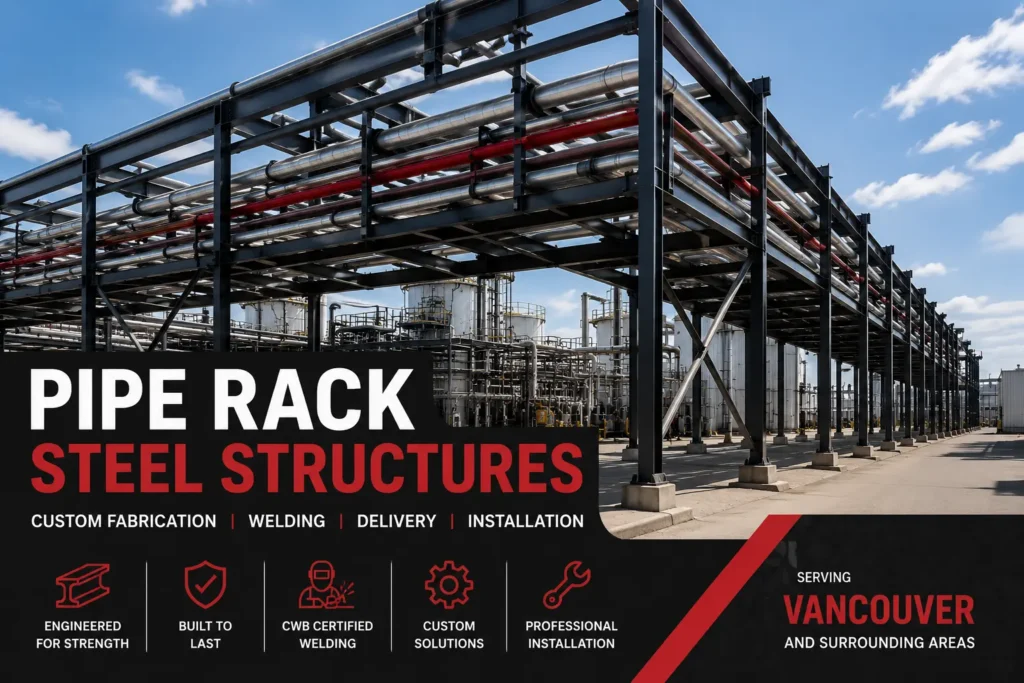
Pipe rack steel structures provide safe and organized support for piping systems, cable trays, conduits, mechanical services, and utility lines in industrial and commercial facilities. These structures are commonly used in manufacturing plants, warehouses, processing facilities, data centres, mechanical rooms, and large commercial buildings.
At Avangard Steel, we provide pipe rack steel structure fabrication, welding, delivery, and installation services throughout Vancouver, North Vancouver, West Vancouver, Coquitlam, Surrey, Burnaby, Richmond, and surrounding areas of British Columbia.
Our team works with engineers, general contractors, developers, and project managers to deliver custom structural steel pipe racks built around approved drawings, site conditions, project schedules, and operational requirements.
Table of Contents
What Is a Pipe Rack Steel Structure?
A pipe rack steel structure is an engineered framework designed to support multiple pipes, cable trays, electrical conduits, mechanical services, and utility systems above the ground.
Instead of installing individual supports throughout a facility, a pipe rack brings different services together within one organized structural system. This improves accessibility, reduces congestion, and helps protect important mechanical infrastructure.
Pipe racks are commonly fabricated from structural steel because steel provides the strength, durability, and flexibility required to support heavy loads over long spans.
Where Are Pipe Rack Steel Structures Used?
Pipe rack systems are used in facilities where multiple mechanical, electrical, or utility systems must travel safely between different areas of a building or site.
- Manufacturing facilities
- Industrial buildings
- Warehouses
- Distribution centres
- Food processing plants
- Water treatment facilities
- Mechanical plants
- Energy facilities
- Data centres
- Commercial buildings
- Utility buildings
- Processing facilities
The structure can be installed indoors, outdoors, between buildings, above equipment, or across operational areas depending on the approved engineering design.
Benefits of Structural Steel Pipe Racks
| Benefit | Value for the Project |
|---|---|
| High Load Capacity | Supports piping, cable trays, mechanical services, and related equipment loads |
| Organized Infrastructure | Keeps multiple building services arranged within one accessible structure |
| Long Span Capability | Allows services to cross open areas with fewer ground level obstructions |
| Future Expansion | Additional pipes or utilities may be added when reviewed and approved by an engineer |
| Maintenance Access | Improves visibility and access for inspection, maintenance, and repairs |
| Durability | Structural steel provides strong and reliable long term performance |
| Custom Design | Can be fabricated around equipment, buildings, access routes, and site conditions |
Types of Pipe Rack Steel Structures
Pipe rack systems can be designed in different configurations depending on pipe quantities, loading, height, span, site access, and future expansion requirements.
Single Level Pipe Racks
Single level pipe racks support one main level of piping or services. They are often used where the number of utilities is limited or where vertical clearance must be maintained.
Multi Level Pipe Racks
Multi level pipe racks provide two or more support elevations. They are suitable for facilities with larger quantities of pipes, cable trays, conduits, and mechanical systems.
Cantilever Pipe Racks
Cantilever systems extend support members from one side of the main structure. They may be used where columns cannot be installed on both sides or where access must remain open.
Pipe Bridges
Pipe bridges carry utility services across roads, loading areas, equipment zones, or spaces between buildings. These structures require careful coordination of clearance, loading, and support conditions.
Modular Pipe Racks
Modular pipe rack components may be fabricated in sections and delivered to the site for installation. This can improve fabrication quality and reduce some on site work when the project conditions allow it.
Structural Components of a Steel Pipe Rack
A pipe rack may include several structural steel components working together to support the required loads.
- Structural steel columns
- Horizontal beams
- Cross bracing
- Longitudinal bracing
- Base plates
- Connection plates
- Pipe support beams
- Cantilever arms
- Access platforms
- Steel stairs
- Guardrails and handrails
- Maintenance walkways
The exact components depend on the engineering design, pipe layout, access requirements, and facility operations.
Pipe Rack Steel Structure Design Considerations
Pipe rack design requires coordination between structural engineers, mechanical engineers, electrical consultants, facility operators, and the steel contractor.
Important design considerations include:
- Pipe weight
- Fluid weight
- Insulation weight
- Cable tray loads
- Mechanical equipment loads
- Thermal expansion
- Wind loads
- Snow loads
- Seismic requirements
- Pipe movement
- Support spacing
- Maintenance access
- Vehicle clearance
- Building clearances
- Future expansion
All structural member sizes, connections, bracing details, and support conditions should follow approved engineering drawings.
Pipe Loads and Structural Support
Pipe rack structures must support more than the weight of the pipes themselves. The design may also account for the weight of liquids, insulation, valves, cable trays, maintenance loads, and movement caused by temperature changes.
Some pipelines may create concentrated loads at specific support locations. Others may expand or contract during operation. These conditions must be considered before fabrication begins.
A properly coordinated pipe rack helps transfer loads safely through beams, columns, bracing, base plates, and foundations.
Thermal Expansion in Pipe Rack Systems
Piping systems may expand and contract as operating temperatures change. This movement can create additional forces on pipe supports and the structural steel frame.
The project engineering team may use guides, anchors, sliding supports, expansion loops, or other details to manage thermal movement.
The pipe rack must be fabricated according to the approved support locations and connection details so the piping system can perform as intended.
Seismic Considerations in British Columbia
Pipe rack steel structures in British Columbia may require seismic design because they support important mechanical, electrical, and utility systems.
The structural design may include bracing systems, reinforced connections, anchorage, and other details intended to transfer seismic loads through the structure.
Avangard Steel fabricates and installs structural steel components according to approved drawings and project specifications.
Pipe Rack Steel Fabrication
Accurate fabrication is essential for a pipe rack steel structure. Columns, beams, braces, plates, and supports must be prepared to match the approved dimensions and connection details.
The fabrication process may include:
- Reviewing structural and mechanical drawings
- Confirming member sizes and material requirements
- Cutting structural steel to length
- Drilling bolt holes
- Fabricating connection plates
- Welding brackets and support components
- Preparing columns and beams
- Completing quality inspections
- Applying specified finishes or coatings
- Organizing components for delivery
Professional fabrication helps improve fit during installation and reduces the risk of delays caused by inaccurate dimensions or missing connection details.
Learn more about our structural steel fabrication services .
Custom Pipe Supports and Steel Components
Pipe rack projects often require custom steel components in addition to the main structural frame.
These components may include:
- Pipe support brackets
- Steel saddles
- Cantilever arms
- Guide supports
- Anchor support frames
- Equipment support frames
- Custom connection plates
- Maintenance platforms
- Access stairs
- Guardrails
Each custom component must match the approved pipe layout, load requirements, elevations, and connection details.
Welding for Pipe Rack Structures
Pipe rack fabrication and installation may require both shop welding and field welding. Welding can be used for structural connections, brackets, support plates, stiffeners, braces, access platforms, stairs, and custom components.
The welding requirements depend on the approved design, material type, connection method, accessibility, and structural loads.
Quality welding is important because pipe racks may support valuable and critical facility infrastructure over long periods of operation.
Protective Coatings and Finishes
Pipe rack steel structures may be installed indoors or exposed to rain, moisture, industrial environments, and changing weather conditions.
Depending on the project specifications, structural steel may receive:
- Primer
- Industrial paint systems
- Galvanized finishes
- Corrosion resistant coatings
- Fire protection coatings
- Custom finish systems
The appropriate finish depends on the service environment, exposure conditions, maintenance expectations, and project requirements.
Galvanized Steel vs Painted Steel Pipe Racks
| Feature | Galvanized Steel | Painted Steel |
|---|---|---|
| Corrosion Protection | Provides strong protection through a zinc coating | Protection depends on surface preparation and coating system |
| Maintenance | May require less frequent maintenance in some environments | May require inspection and recoating over time |
| Appearance | Standard metallic galvanized finish | Available in different colours and coating systems |
| Project Use | Common for exterior and exposed applications | Common for interior and controlled industrial applications |
| Selection | Based on exposure and project specifications | Based on environment, appearance, and maintenance requirements |
Pipe Rack Steel Structure Installation
After fabrication, the structural steel components are delivered to the project site for installation.
The installation process may include:
- Delivery coordination
- Site access review
- Crane and lifting coordination
- Column installation
- Beam installation
- Bracing installation
- Bolted connections
- Approved field welding
- Alignment and elevation checks
- Platform and stair installation
- Final scope review
Installation sequencing must be coordinated with foundations, piping contractors, mechanical trades, electrical trades, access requirements, and the general construction schedule.
Pipe Rack Installation Near Existing Operations
Some pipe rack projects are completed inside active facilities where production, storage, deliveries, or equipment operations must continue.
These projects require careful planning around work zones, lifting paths, temporary access restrictions, shutdown periods, and trade coordination.
Clear communication between the owner, contractor, engineer, and installation team helps reduce disruption and maintain a safe working environment.
Pipe Rack Structures for Manufacturing Facilities
Manufacturing facilities may use pipe racks to support compressed air lines, process piping, water lines, electrical conduits, cable trays, ventilation services, and other production systems.
An organized pipe rack can improve access to utilities while keeping floor areas available for machinery, production lines, forklifts, and material movement.
The structure may also include platforms, ladders, stairs, and maintenance access depending on operational needs.
Pipe Rack Structures for Warehouses
Warehouses may require pipe racks for fire protection lines, electrical services, mechanical systems, refrigeration piping, compressed air, or utility distribution.
Steel pipe racks can help route these systems above loading, storage, and operational areas while maintaining required clearances.
The pipe rack may connect with the main warehouse steel structure or function as an independent engineered support system.
Pipe Rack Structures for Data Centres
Data centres contain extensive cooling, electrical, fire protection, and mechanical infrastructure. Structural steel pipe racks can support organized routing of these systems while helping maintain access for inspection and maintenance.
The design may need to coordinate with server areas, cooling equipment, generators, electrical rooms, cable systems, and future expansion plans.
Pipe rack fabrication for data centres requires accurate dimensions and close coordination with mechanical, electrical, structural, and construction teams.
Pipe Rack Structures for Water Treatment Facilities
Water and wastewater treatment facilities often require large quantities of process piping and utility services. Steel pipe racks can support these systems across treatment areas, equipment zones, and between buildings.
Because these environments may involve moisture and chemical exposure, material selection and protective coatings are important project considerations.
Pipe Rack Structures for Commercial Mechanical Systems
Large commercial buildings may use structural steel supports for mechanical piping, heating and cooling lines, fire protection systems, electrical conduits, and rooftop or service area infrastructure.
Custom steel pipe racks can help organize these systems while providing support across open areas or between equipment zones.
Pipe Rack Steel Structures and Open Web Steel Joists
Pipe rack structures and open web steel joists serve different purposes, but both may be part of the same commercial or industrial project.
Open web steel joists are commonly used to support roof or floor systems, while pipe racks are designed to support piping, conduits, cable trays, and mechanical utilities.
Some projects require coordination between pipe rack elevations, roof joists, structural beams, mechanical systems, and building clearances.
Learn more about our open web steel joist services .
Pipe Rack vs Individual Pipe Supports
| Feature | Pipe Rack Structure | Individual Pipe Supports |
|---|---|---|
| Number of Services | Supports multiple piping and utility systems | Usually supports one pipe or a small group |
| Organization | Creates one coordinated structural route | Uses separate supports across the facility |
| Span | Can cross larger open areas | Typically used for shorter support distances |
| Expansion | May allow coordinated future services | Additional supports may be required |
| Best Use | Industrial facilities with multiple utility systems | Smaller or isolated piping applications |
Can Existing Pipe Racks Be Expanded?
Some existing pipe rack structures can be expanded, extended, or reinforced to support additional piping or utilities. However, the existing structure must first be reviewed by a qualified engineer.
The review may consider:
- Existing member capacity
- Foundation capacity
- Connection capacity
- New pipe loads
- Thermal forces
- Wind and seismic loads
- Condition of existing steel
- Required reinforcement
Approved reinforcement may include new beams, additional columns, braces, plates, supports, or connection modifications.
Pipe Rack Repair and Modification
Pipe racks may require repairs or modifications due to corrosion, impact damage, equipment changes, new piping, building expansion, or operational upgrades.
Possible work may include:
- Replacing damaged members
- Adding reinforcement plates
- Installing new supports
- Extending existing frames
- Adding bracing
- Repairing connections
- Installing access platforms
- Completing approved field welding
Structural repairs and modifications should always follow approved engineering details.
Our Pipe Rack Project Process
1. Send Us Your Project Details
Send drawings, specifications, site photos, dimensions, schedules, and any available mechanical or structural information.
2. Scope Review and Quote
Our team reviews the structural scope, fabrication requirements, installation details, finishes, access conditions, and project schedule before preparing a quote.
3. Drawing and Detail Coordination
Member sizes, connection details, support locations, elevations, bracing, and access requirements must be confirmed through approved project documents.
4. Fabrication
Columns, beams, braces, plates, brackets, platforms, stairs, and other components are fabricated according to the approved drawings.
5. Delivery and Installation
The completed steel components are delivered to the site and installed according to the approved scope, access plan, and construction schedule.
6. Final Review
After installation, the completed work is reviewed against the approved scope and any authorized project changes.
Why Choose Avangard Steel?
Avangard Steel provides structural steel fabrication and installation support for industrial, commercial, warehouse, mechanical, and infrastructure projects throughout British Columbia.
- CWB certified company
- Structural steel fabrication capabilities
- Professional installation support
- Commercial and industrial project experience
- Custom pipe rack fabrication
- On site welding capabilities
- Access platform and stair fabrication
- Project coordination with contractors and engineers
- Quality focused workmanship
- Service throughout Metro Vancouver and surrounding areas
Our team can support pipe rack projects together with structural columns, beams, braces, platforms, stairs, railings, joists, supports, and custom steel components.
Areas We Serve
Avangard Steel provides pipe rack steel structure services throughout:
- Vancouver
- North Vancouver
- West Vancouver
- Burnaby
- Coquitlam
- Surrey
- Richmond
- Langley
- Delta
- New Westminster
- Port Coquitlam
- Port Moody
- Maple Ridge
- The Lower Mainland
- Surrounding areas of British Columbia
Frequently Asked Questions
What is a pipe rack steel structure?
A pipe rack steel structure is an engineered steel framework used to support piping systems, cable trays, conduits, mechanical services, and utility infrastructure.
Where are steel pipe racks used?
They are commonly used in manufacturing facilities, warehouses, data centres, water treatment plants, industrial buildings, processing facilities, and large commercial properties.
Why is structural steel used for pipe racks?
Structural steel provides high strength, long span capability, durability, and flexibility for custom support configurations.
Can pipe racks support electrical cable trays?
Yes. Pipe rack structures may support cable trays, electrical conduits, mechanical piping, fire protection lines, and other utility systems when included in the approved design.
Can an existing pipe rack be expanded?
It may be possible to expand or reinforce an existing pipe rack, but the structure and foundation must first be reviewed by a qualified engineer.
Do pipe racks require engineering?
Yes. Structural member sizes, connections, bracing, foundations, and support details should be designed and approved by qualified engineering professionals.
Do you provide both fabrication and installation?
Yes. Avangard Steel provides structural steel fabrication, welding, delivery, and installation support for approved pipe rack projects.
Can you fabricate access platforms and stairs for pipe racks?
Yes. We can fabricate structural steel platforms, stairs, guardrails, handrails, ladders, and related access components based on approved project drawings.
What finishes are available for pipe rack steel?
Available finishes may include primer, industrial paint systems, galvanized coatings, corrosion resistant coatings, and other finishes specified for the project environment.
Which areas do you serve?
We serve Vancouver, North Vancouver, West Vancouver, Burnaby, Coquitlam, Surrey, Richmond, Langley, Delta, and surrounding areas of British Columbia.
Request a Quote for a Pipe Rack Steel Structure
Planning an industrial facility, warehouse, data centre, processing building, mechanical plant, or commercial project that requires a custom pipe rack steel structure?
Send Avangard Steel your drawings, specifications, site information, required finishes, and project schedule. Our team will review the scope and prepare a quote based on the available project details.